

The Story Behind OCP Military Uniform
Nov 19, 2021
To understand the military, you must understand the uniforms and the significance they bring on the field. As long as there has been a military, there has been a uniform to go with each branch. Each one is significantly different to identify members of one branch from those of another. Camouflage is a very new idea among the military that came about at the turn of the century. This is the story behind the OCP military uniform as we know it today.
The Camo of WWI and WWII
During the First World War, there was an interesting tactic that the French allied troops deployed, which they referred to as a concealment technique. Later, the British forces would implement a similar idea when Alister Mackenzie proposed it for use in the trenches. The aim was to prevent soldiers from being visible at long distances. Around the same time, the US Navy implemented these same tactics through a team of what they called “camofleurs,” who were part of the special Women’s Camouflage Reserve Corps of the National League for Women’s Service.
Eventually, the military would develop what would come to be known as “rock suits,” also known as “observation suits.” These would become the prototype of the ghillie suit that special forces sniper troops wear in the field. While in the South Pacific at the time of the second world war, the marine corps would adopt what would be known as the “frog suit” featuring reversible patterns. One side had a jungle mesh camo pattern, while the inside had a desert pattern for alternating terrain while out in eastern regions.
Camo in Vietnam and the Cold War
Fast forward a few decades during the Vietnam war, and camouflage nearly became a forgotten relic of the past until the “boonie” suit arrived. Still, only the special forces were issued the suit during the war, and the military phased it out early due to lack of productivity in the jungle. During the Cold War, the M81 Woodland pattern would appear on the new Battle Dress Uniform (BDU) for those out in the field. It carried on for quite some time before the military phased it out in the 2000s.
Gulf War Camo Evolution
During the 1990s, what came to be known as the “chocolate chip” desert camo uniform (DCU) would begin to replace the older BDUs. In 2002, the Marine Corps decided that it needed its own identity and thus its own camouflage. Through the efforts of Lt. Colonel Timothy O’Neill, a camouflage specialist, the Marine Corps was able to create something that people could not see downrange. It accomplished this by computing a specific digital design that scopes and computers could not replicate during wartime. The pattern would come to be known as the MARPAT or Marine pattern.
The MARPAT and Its Followers
The Army sought to copy the MARPAT but had very weak results, as it spent $5 billion on what would come to be known as the Universal Camouflage Pattern (UCP). And in 2004, it changed its uniform to the Army Combat Uniform (ACU). The ACU was the least effective uniform in military history.
Fast forward to 2010, and the US Navy tried its hand at the camouflage technology and created the “blueberry” uniform pattern that was almost identical to the MARPAT, apart from its blue hues. The Navy would soon retire this uniform and adopt the Type I MARPAT and then the Type III MARPAT, which is still in use today. These are some of the most effective uniforms in the field, sea, and air.
Most recently, the Navy would switch to the AOR1 and the AOR2 digital camouflage, which are desert and woodland patterned, respectively. This would be a massive upgrade from the digital BDU, which cloned the MARPAT yet had no function other than mirroring the sea.
The Army and Airforce OCP
The Army and Air Force decided to come together to work on uniforms recently as well. The old woodland pattern that they used during the Cold War was in dire need of an update. The result of this was the Airman’s battle uniform (ABU), which became official in 2007.
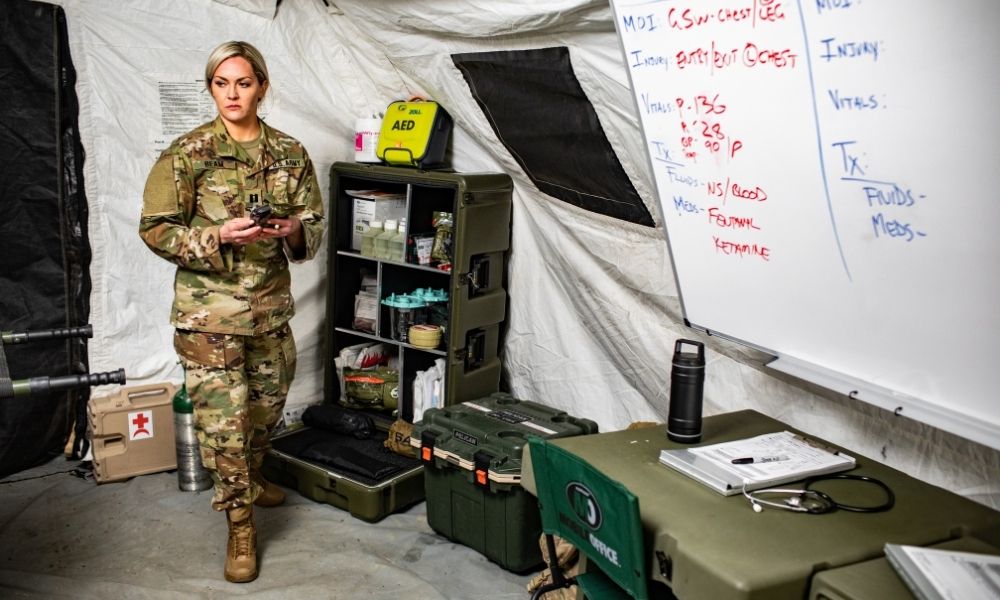
As stated earlier, both the Army and the Air Force would join in their quest for the ultimate camouflage pattern. The fruits of their labor culminated in the OCP Multicam patterned USAF uniform. The pattern featured four distinct colors: muted green, light beige, and two types of brown, and members of both branches now wear it universally. This was the latest upgrade from the digital UCP pattern.
Uniform Recap
Studying differing terrain and figuring out how to adapt to that terrain proved highly impactful when the “rock suit” came into use to mask the whereabouts of soldiers during combat. This would later evolve into sniper units' ghillie suits, which mimic nature around the wearer. The frogmen of the Second World War made a valiant effort to be unique, even though their uniforms looked astonishingly like some of the German forces, resulting in more friendly fire situations than anticipated.
Then in the 1980s, there was a renaissance for camouflage as the woodland uniform came into existence and stayed for a decade, branching out among various forces for some time afterward. Finally, the Marine Corps would engineer a modern marvel through its MARPAT digital camouflage pattern. This design made it impossible for scopes or computing technologies of any kind to trace wearers for miles.
The Army made an additional effort to keep up with the marines at around the same time. It created the Universal Camo Pattern that did not come close to what the Marine Corps had achieved, thus making it the most ineffective uniform to date. The color schemes could not hide or protect soldiers and airmen as they really did not blend well with the environment. The Army and did not research and develop the pattern well enough to work in its corresponding terrain. These events all come together to create what has come to be known as the story behind the OCP military uniform as we know it today.
